About
Resonant City is an interdisciplinary research collaborative exploring the intersections of art, architecture, technology, the immediate past, enduring present, and possible futures. In the course of our explorations we hope to illuminate a subtle yet critical discourse underlying the construction of nature, landscape, the city, aesthetic and cultural production.
Welcome to Resonant City.
soon to be picturesque ruins
Links
- A Young Hare
- a456
- afterall
- airoots/eirut
- ANY-SPACE-WHATEVER
- Ballardian
- BLDG/BLOG
- boiteaoutils
- Charnel House
- City of Sound
- Crimson Architectural Historians
- David Gissen
- deconcrete
- diffusive architectures
- ditchcat
- DPR-Barcelona
- e-flux
- Edible Geography
- Entschwindet und Vergeht
- Everyday Structures
- eyeteeth
- fantastic journal
- GAFFTA
- indiemaps
- InfraNet Lab
- Javier Arbona
- Kazys Varnelis
- LA Eastside
- Lebbeus Woods
- M.ammoth
- Marius Watz
- owen hatherley
- Postarchitectural
- pruned
- Serial Consign
- Spatial Agency
- Strange Harvest
- Strange Maps
- Territorial Masquerades
- The Funambulist
- Triple Canopy
- Urban Landscape Lab
- urbanscale
Upcoming Events
- Events on May 28, 2013
- LORDY RODRIGUEZ Code SwitchStarts: 1:00 pmEnds: May 28, 2013 - 2:00 pmLocation: Hosfelt Gallery 260 Utah Street San Francisco, CA 94103
28 May - 13 July 2013
Reception: Saturday 8 June, 4 - 6pm
LORDY RODRIGUEZ
Code Switch
In his fifth solo exhibition at Hosfelt Gallery, Lordy Rodriguez presents new works on paper that utilize the map as a framework in which to experiment with unorthodox combinations of familiar visual languages from a variety of sources, including advertising, reality TV, fashion, gift-wrapping, and signature images associated with celebrity artists. With humor, craft, and adept analysis of popular culture, Rodriguez shrewdly subverts the fundamental purpose of design - to create something in the most beautiful and functional way - and the fundamental purpose of maps - to locate and transport ourselves in the world.
In linguistics, "code-switching" means mixing languages or patterns of speech in conversation. Rodriguez applies this concept to the visual languages of popular culture, using the vocabulary of cartography as a 'grammatical backbone.' In this process, he has developed his own lexicon and 'signature style,' while disrupting our conditioned expectations of the function and meaning of symbols and design.
Maps describe a place, and by extension an identity. Brand-name patterns and logos are also symbolic of identity, in terms of culture, class, and status. In Gangnam, America, Rodriguez remaps the country by 'cultural capitols' - i.e. entertainment districts in the US as defined by Wikipedia. In most cases, these were historically gay or ethnic neighborhoods, now branded and transformed, through appropriated, watered-down 'culture' from elsewhere, into centers of pop culture - essentially shopping and nightlife. America here is an ostentatiously elongated island floating in a Burberry sea.
The boundaries between ostensibly opposed cultural referents like mass-produced consumer goods and original, high-end art are increasingly blurred. Several works riff on motifs associated with luxury brands, like Michael Kors and Louis Vuitton, and celebrity artists Takashi Murakami and Damien Hirst. Like the instantly recognized Louis Vuitton monogram, Murakami's mushrooms and Hirst's dots have infiltrated global markets, reproduced on coveted products synonymous with wealth, taste and prestige.
Rodriguez began working with the vocabulary and concept of the map just as the digital revolution was propelling the shift from paper maps to map apps. The same technology is driving the rapid transformation of language and communication. The speed in which cultural memes are transferred almost overcomes the rate at which we can absorb them. Our vernacular has become a hodge-podge of cultural references, idioms, tropes, and entirely new words or new meanings for words. The work in Code Switch represents Rodriguez's experiments in 'code-switching' the visual languages of popular culture in an ongoing exploration of real and virtual place and identity.
Lordy Rodriguez was born in the Philippines and raised in Texas and Louisiana. He received a BFA from the School of Visual Arts in New York and an MFA from Stanford University. In 2009 his work was the subject of solo exhibitions at the Austin Museum of Art in Texas and the Nevada Art Museum in Reno. Rodriguez teaches at UC Berkeley.
- RINA BANERJEE Tender Mahal - LiftedStarts: 1:00 pmEnds: May 28, 2013 - 2:00 pmLocation: Hosfelt Gallery 260 Utah Street San Francisco, CA 94103
28 May - 13 July 2013
Reception: Saturday 8 June, 4 - 6pm
RINA BANERJEE
Tender Mahal - Lifted
For her first project at Hosfelt Gallery, Rina Banerjee brings together a monumental, pink, Mughal-inspired sculpture and a group of her delicate and sensuous paintings on paper, in a paean to the potential of 21st century love.
Banerjee, who was born in Kolkata, India and lives in New York, works with a cosmopolitan eclecticism that reflects both her transnational background and her sophisticated understanding of the narrative power of objects. Using trinkets made for the tourist trade, horn, bone, feathers, shells, textiles, glass bottles and antiques - she assembles rapturous sculptures that are mystifyingly shamanistic, yet overflowing with connotation. Her works are hyper-ornamented and lushly seductive. Conjoining rarities with cheap, mass-produced bric-a-brac, she appropriates extravagantly while rejecting hierarchies of material, culture and value.
The sculpture at the center of this installation takes its form from the Taj Mahal. Often cited as the most beautiful building in the world, it is the epitome of Mughal architecture - an amalgam of elements of Islamic, Persian, Ottoman Turkish and Indian styles - a design hybrid born of two thousand years of incursions, migrations, invasions and colonization. The Taj Mahal is also the world's most famous monument to romantic love - a lavish and unabashed public display of affection.
Banerjee's palace is rendered in pink plastic rather than white marble. It's decorated with fake pearls, cowrie shells and florist's moss rather than jade, turquoise and carnelian. A marriage of high and low culture, it is a mutation - emblematic of a world constantly in flux - of societies continuously reshaping their belief systems. It is a refusal to make judgments based on traditional notions of beauty, importance, worth or usefulness. For the first time in history, Banerjee argues, humanity has an opportunity to consider love outside concerns of reproduction or patrimony and beyond issues of race, gender or religion. This exhibition is a tender tribute to the emergence of love for the sake of love.
Rina Banerjee received a BS in Polymer Engineering and worked as a research chemist before completing her MFA at Yale in 1995. Her work was included in the 2000 Whitney Biennial, the 2005 Greater New York Show at PS1/MOMA, and will be in the upcoming 2013 Venice Biennale's Murano Glass Project. The Smithsonian Museum's Sackler Gallery will present a solo exhibition of her work opening July 6. Her work is in the collections of the Centre Georges Pompidou (Paris), the Whitney Museum of American Art, The Brooklyn Museum, Berkeley Art Museum, SFMOMA, the Hammer Museum (Los Angeles), and many others.
------------------------------------------------------------------------------------------------------------
- Events on May 31, 2013
- Friends, Family, Neighbors: David Gregory WallaceStarts: 8:00 pmEnds: May 31, 2013 - 10:00 pmLocation: Royal NoneSuch Gallery 4231 Telegraph Ave. Oakland, CA, 94609
An automated shadow puppet machine installed in the front window of the gallery, for which the exhibition is named, utilizes 160 color slide portraits taken of over 50 people from the artist’s daily life. Portraits of loved ones, roommates, co-workers and neighbors are projected on the window as a flock of shadow birds and the silhouette of a Predator drone move across their faces. For the video loop 'This is where we live', Wallace has constructed a classic A-frame house out of drone footage found on the internet. Most of the videos are of successful targeted strikes on supposed insurgents or terrorists--attacks which often also kill civilians. In contrast to the portraits of the artist’s friends, family and neighbors in the window installation, the people captured in the drone footage lack recognizable characteristics and remain anonymous. A short video, 'Predator', depicts a boy flying a model drone through private and public spaces around the East Bay. Predator reflects on our shared complicity in the use of drones as well as our simultaneous vulnerability in a world where they have become ubiquitous.
http://www.royalnonesuchgallery.com/
- Events on June 12, 2013
- N.E.A Panel discussion at Gallery 16Starts: 6:00 pmEnds: June 12, 2013 - 9:00 pmLocation: Gallery 16 501 Third Street San Francisco, CA 94107
http://http//www.gallery16.com/
As part of our 20th Anniversary Conversation series, Gallery 16 is proud to present a rare opportunity to hear about events that led to the turbulent period called the Culture Wars from those at the center of the debate. This is a unique opportunity to learn about the political, legislative and cultural maneuvering that led to the battle over Federal arts funding and the removal of Richard Serra’s Tiltled Arc. As well as the on going argument over of Federal support of the Arts.
Our panel will include former US Congressman Pat Williams, artist and former Director of the NEA Visual Arts program Jim Melchert and Renny Pritikin, Former Director of the Yerba Buena Center for the Arts. Lovers of the arts today may not recall the perilous future the National Endowment For The Arts faced back in the late 80’s and early 90’s, but it was close to extinction. Today we are reminded that the forces that sought to dismantle the NEA in the 90’s are still at work. This past November, a condensed version of David Wojanrowitz film A Fire in My Belly was removed from the exhibit Hide/Seek: Diöerence and Desire in American Portraiture” at the Smithsonian’s National Portrait Gallery in response to complaints from Representative John Boehner, who had neither seen the video or the exhibition.
Artist Jim Melchert’s influential and varied career has taken many forms.
He has degrees from Princeton, University of Chicago and studied under
Peter Voulkos at the University of California, Berkeley where he became
a professor. In 1977 the National Endowment for the Arts brought
him to Washington, DC to direct its Visual Arts Program for four years.
From 1984 to 1988 he joined the American Academy in Rome as Director.
His work as a conceptual ceramic artist has led to exhibitions at the
Whitney Museum, the Museums of Contemporary Art in Chicago, Houston,
and Los Angeles; the Museum of Fine Arts in Houston; at the Museums
of Modern Art in San Francisco, Tokyo, and Kyoto; The Los Angeles
County Museum of Art; the Victoria and Albert Museum in London and
Documenta 5 in Kassel, Germany.
Rep. Pat Williams served as Chairman of the House Committee that
oversaw fiscal authorization for the NEA. He was one of the most vocal
champions for Federal Arts Funding and has been credited for saving the
NEA. Pat Williams, who served Montana as its U.S. Congressman for nine
terms, from 1979-1997, is well known for his staunch advocacy to save the
National Endowment for the Arts. When the National Endowment for the
Arts came under attack for subsidizing what some legislators considered
sexually explicit art, Williams led the fight to save the agency.
“As long as the federal government can support the arts without interfering
with their content, government can indeed play a meaningful part in
trying to encourage the arts,” Williams told The New York Times. “The genius of the NEA has been that the peer- review panels, made up of local
folks, chose art and artists by using criteria based upon quality and excellence, never touching subject matter.” “He was a tireless and fearless supporter of the arts,” reports John Frohnmayer, who served as chairman of the National Endowment for the Arts during that tumultuous era. “He risked his political career in doing so.”Frohnmayer recalls that Williams “called out the congressional critics of the Endowment for their duplicity and moral posturing.”
Renny Pritikin has held three positions in arts organizations in Northern
California over the past thirty years. For more than a decade he was
director of New Langton Arts in San Francisco, an alternative space that
specialized in new and experimental work in visual art, performance, new
music, and literature. Following that, he was chief curator at Yerba Buena
Center for the Arts, San Francisco. Until recently he was director and
curator of the Nelson Gallery and Fine Art Collection at the University of
California, Davis.Renny is a Fulbright Fellow and a Koret Fellow. He has published three books of poetry, most recently in 2007 from POD Press in San Francisco,and published dozens of catalogue essays, both in the United States and in Japan, and Germany. He is a senior adjunct professor at the California College of the Arts’ curatorial studies graduate program since 2001.
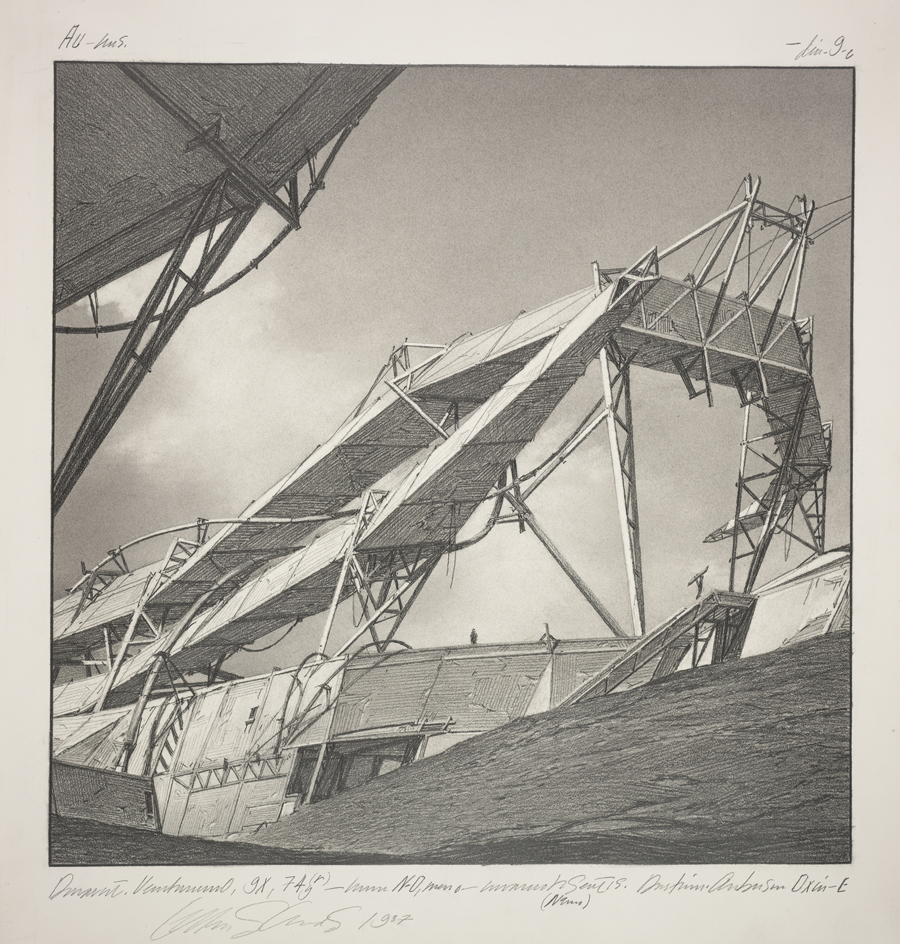
Lebbeus Woods, Architect
Lebbeus Woods was a singular figure in architecture. He was an outsider, yet quietly influential to architectural thinking over the past three decades. He was a humanist, a deconstructionist, a…
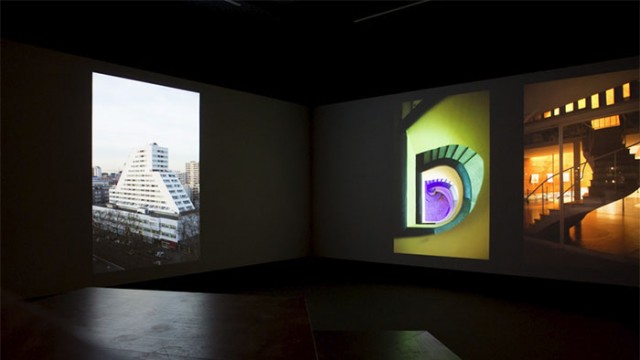
Interstitial Spaces: The Visual Dreams of Filip Dujardin and Lauren Marsolier
Photomontage is a technique that has long been used by artists to create new visions of reality. Its use can be traced back to the origins of photography; double exposures…
Driss Ouadahi: Trans-Location
Trans-Location, at San Francisco’s Hosfelt Gallery, features new paintings by Driss Ouadahi. Ouadahi was born to Algerian parents in Casablanca, Morocco and studied architecture in Algeria before attending the Kunstakademie…
Warren Ellis’ Gun Machine
Gun Machine is a tightly wound, little beast of a detective novel. The story begins with two NYC detectives who stumble into an explosive situation. An angry, naked man with…
The Urban Narrative: Local History Tours and Place-Marking as Sites of Contestation.
Part two of our mapping series. See Part one Mapping Histories History is never objective—interpretations of events always vary depending on whose perspective is prioritized. It is always a process…
Recent
-
Architecture
Lebbeus Woods, Architect
No Comments -
Art
Interstitial Spaces: The Visual Dreams of Filip Dujardin and Lauren Marsolier
No Comments -
Art
Driss Ouadahi: Trans-Location
No Comments -
Things We Like
Warren Ellis’ Gun Machine
No Comments -
Architecture
The Urban Narrative: Local History Tours and Place-Marking as Sites of Contestation.
No Comments -
Things We Like
Doug Aitken and DS+R Only Have Eyes for the Hirschorn
No Comments -
Art
Mitzi Pederson’s Ciphers at Ratio 3
No Comments -
Reviews
Ken Wark’s The Beach Beneath the Street
No Comments -
Things We Like
Doris Salcedo
No Comments -
Things We Like
The Macula turns chapel into massive virtual instrument controlled by lasers
No Comments -
Essays
Bicycle-Powered Haberdasheries of the World, Unite!
No Comments -
Things We Like
Tim Doyle’s Unreal Estate
No Comments -
Essays
Mapping Histories: Map APIs and the visualization of historical archives
No Comments -
Things We Like
Sebastien Preschoux: Installations in the Interstices of Yarn and Oblivion
No Comments